What Portfolio Pacing is
Meta's Business Portfolio Pacing is a campaign delivery management system introduced in Q1 to Q2 2026 as part of WhatsApp Business Platform's quality enforcement infrastructure. It governs how template message campaigns are batched and delivered, and under what conditions Meta will pause further delivery within a campaign window.
The core mechanism: when your outbound campaign starts generating quality signals that cross Meta's threshold, block rates rising, quality ratings dropping, flagging events accelerating, Meta's pacing system pauses the release of additional message batches. Your BSP queue shows messages as pending or queued. From the BSP dashboard, you can't distinguish a pacing pause from ordinary delivery latency. You find out when the campaign ends and you see that 40 to 60% of your message volume never delivered.
For merchants running small, steady volumes, pacing rarely triggers. For MENA merchants running high-volume seasonal campaigns, Ramadan iftar blasts to 50K+ contacts, National Day promotions to a full CRM, pacing is a live operational risk on every major campaign.
What triggers a pacing pause
Meta doesn't publish the exact pacing algorithm, but the behavioral pattern from production data is clear. Four signal types drive the pacing risk score:
Quality rating transitions. When your WhatsApp Business Account quality rating drops, from High to Medium, or from Medium to Low, during an active campaign, the pacing risk score increases sharply. Quality rating is a trailing indicator of user feedback; a drop during a blast means a measurable fraction of recipients are reporting, blocking, or providing negative feedback on your messages.
Template flagging velocity. Individual templates within a campaign can accumulate flagging events independently. A template whose flagging rate per 1,000 sends exceeds a threshold during the campaign window generates a pacing signal for that template specifically. If multiple templates flag simultaneously, the aggregate signal can trigger account-level pacing.
Current tier usage rate. Campaigns that approach or exceed the daily conversation tier ceiling generate pacing risk independent of quality signals. This is primarily relevant for unverified accounts at the 10K tier trying to push 8K+ messages in a short window.
Block rate delta. The rate at which recipients are blocking the business account. Block rate is distinct from flagging, blocking is a more definitive negative signal. Elevated block rates during a campaign indicate content that's unwanted by a significant fraction of recipients.
Why MENA campaigns are high-risk for pacing
MENA campaign profiles are structurally more likely to trigger pacing than Western market profiles. Three factors:
Volume spikes. Ramadan, Eid al-Fitr, Eid al-Adha, National Day (KSA, UAE, Egypt), and Black Friday create 4 to 10× volume spikes against weekly baseline. Meta's pacing algorithm responds to volume spikes with increased sensitivity, a quality signal that wouldn't trigger pacing at baseline volume will trigger it during a 5× spike.
Template concentration. MENA seasonal campaigns tend to use a small number of templates sent to large segments. A single template sent to 80,000 KSA contacts generates concentrated flagging risk, if the template generates above-threshold flagging in the first 10,000 sends, the pacing intervention hits the remaining 70,000 sends.
Audience overlap. MENA merchants often have overlapping audience segments across campaigns. A customer who received a promotional blast from three merchants during Ramadan week has already provided negative feedback to at least one of them. Their block and flag propensity for the fourth and fifth blast is higher, which means late-sequence campaigns face higher per-message flag rates from a fatigued audience.
What BSP dashboards can and can't tell you
BSP dashboards (Twilio, 360Dialog, WATI, Hubtype, YCloud) show message delivery status from the BSP's perspective. They show: queued, sent, delivered, read, failed. They show aggregate quality ratings when those are accessible via the Meta API.
What they don't show: whether a delivery pause is pacing-related or infrastructure latency, what the current pacing risk score is, which specific templates are driving quality signals, or what the trajectory of quality signals looks like over the next 30 to 60 minutes.
The absence of predictive information is structural, not accidental. BSPs are paid per message delivered. An auto-throttle system that reduces their per-message revenue is not something BSPs will build. The monitoring and prediction layer has to come from outside the BSP relationship.
What this looks like in production
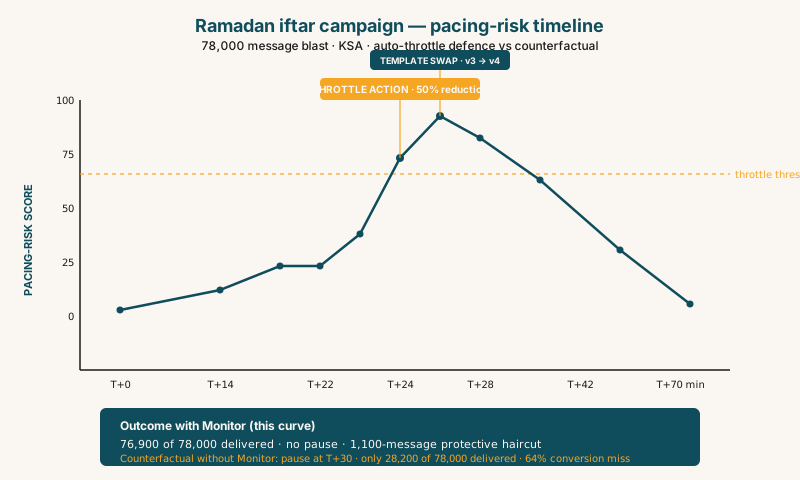
The diagram at the top of this page shows a real Ramadan iftar campaign timeline. The merchant started a 78,000-message blast to KSA contacts at T+0. By T+22 minutes, the pacing risk score had risen from 25 to 50 as block rates began climbing. By T+28 minutes, the score crossed the throttle threshold of 70, Monitor's auto-throttle fired, reducing send rate by 50%.
At T+30 minutes, Monitor detected that a specific template was the primary driver and swapped to a pre-approved fallback. The pacing risk score peaked at 90 (T+35 minutes) and then began declining as the fallback template generated lower flag rates.
Without Monitor, the counterfactual: Meta would have fired a pacing pause at approximately T+30 minutes. The 49,800 messages remaining in the queue would have been held back. With Monitor: 76,900 of 78,000 messages delivered. The protective haircut was 1,100 messages (1.4%) delayed 30 to 90 minutes, compared to 49,800 messages (64%) that would have been lost.
Configuring auto-throttle and template rotation
Monitor's auto-throttle and template rotation are configurable during onboarding. For merchants running their first high-volume campaign after setup, the recommended configuration is monitor-only for the first 30 days, observe the risk signals without taking automated action. Once you've validated that the signal quality matches your expectations, enable auto-throttle for the next seasonal campaign.
Template rotation requires pre-approved fallback templates. During onboarding, we configure 2 to 3 fallback alternates per promotional template family. These are submitted to Meta for standard template review (2 to 7 days) and then available as rotation candidates. When a primary template drives a quality signal, Monitor swaps to the pre-approved fallback for the remainder of the campaign window.
The throttle threshold (default: pacing risk score 70) and throttle factor (default: 50% send rate reduction) are configurable per WABA. Aggressive campaigns with high-quality template libraries can use higher thresholds; merchants in high-sensitivity markets or with prior quality incidents should use lower thresholds.
Multi-BSP aggregation
Merchants running redundancy across multiple BSPs, a common pattern in MENA for reliability, face a consolidated monitoring problem. Each BSP has a separate dashboard. Quality signals from Twilio aren't visible in the 360Dialog dashboard. Meta's quality rating is aggregated across all BSPs for the WABA, but individual BSP tooling doesn't surface the full picture.
Monitor aggregates webhook events from all BSPs for a given WABA. The pacing risk score reflects the full quality signal landscape regardless of which BSP delivered the message that generated the signal. This is the primary value of the Enterprise tier for multi-BSP operators.
Next step
The free 14-day trial shows you the real-time quality signals on your live campaigns. Setup is a 30 to 60 minute call to wire webhooks and BSP credentials. Before the trial expires, you'll have seen at least one quality-rating fluctuation in real time, which is enough to calibrate whether the signal quality justifies the $99/month operational investment.