What changed on April 1, 2026
On April 1, 2026, Meta implemented a tiered pricing restructure for WhatsApp Business Platform template messages in Saudi Arabia. Marketing-category templates increased from approximately $0.029 per delivered conversation to approximately $0.115, a 3 to 4× jump applied uniformly across all Saudi recipients, regardless of template volume or BSP relationship.
Utility-category templates were not affected. They held in the $0.026 to $0.030 per delivered conversation band. For the first time in WhatsApp Business Platform's commercial history, the marketing-vs-utility classification decision has direct, significant, and immediate financial consequences for MENA operators.
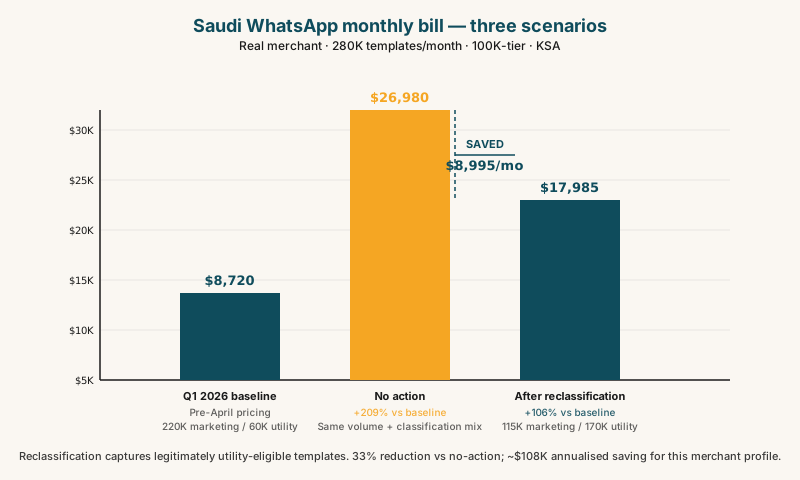
The scale matters. A merchant pushing 200,000 templates per month into KSA, with a typical 70% marketing / 30% utility split, went from approximately $8,720/month to approximately $26,980/month in a single billing cycle. The 3-month annualized delta is over $218,000. The classification decision that used to be an administrative footnote is now a material financial variable.
Why most template libraries are incorrectly classified
MENA template libraries were overwhelmingly built between 2022 and 2024, when the marketing/utility price differential was minimal (under $0.005 per conversation). During that period, the pragmatic choice for most teams was to submit ambiguous templates as "marketing", the review process was simpler, the approvals were faster, and the cost difference was negligible.
Meta doesn't retroactively reclassify templates based on content drift or market changes. A template submitted as marketing in 2023 is still billed as marketing in 2026, regardless of whether its content pattern now clearly matches utility criteria. Reclassification requires deliberate action: a new version submitted with the corrected category.
This creates a systematic mispricing problem. Merchants are paying marketing rates for templates that would pass utility review today. The correction is available; it just requires knowing which templates qualify and going through the resubmission process correctly.
The seven reclassification-eligible patterns
Meta's utility category is defined by function, not by surface-level phrasing. A template qualifies as utility when it facilitates a specific, ongoing transaction or fulfils a concrete obligation the business has already undertaken. The seven patterns that consistently pass utility review in KSA:
Order status updates. Messages triggered by a state change in an existing order, confirmed, dispatched, out for delivery, delivered, exception. The trigger must be automated from a fulfillment system event, not scheduled as a batch campaign.
Payment confirmations and receipts. Post-transaction confirmations of a payment received, invoice issued, or subscription renewed. Must reference a specific transaction. Generic "your payment was processed" messages with no transaction reference fail; "Your payment of SAR 249 for order #KSA-20489 was received" passes.
Appointment reminders. Reminders for appointments, reservations, or bookings the user has already made. Must reference a specific scheduled interaction (date, time, service). Must not contain upsell or promotional content.
Account-activity notifications. Security alerts, login confirmations, password reset confirmations, OTPs (though OTPs have their own separate category), and account-state change notifications. These are the clearest utility cases and almost never require rewriting.
Delivery and logistics updates. Shipping carrier updates, customs clearance notifications, return status updates. Must reference a specific shipment or return case. Broad "your package is on the way" without tracking context fails.
Support case updates. Status updates on an open support ticket, case resolution confirmation, or follow-up on a filed complaint. Must reference a specific case number or interaction. "Your case has been escalated" without a case reference fails.
Subscription and service renewals (transactional framing). Renewal confirmation messages sent after a subscription renews (not before as a marketing push). "Your ShiftKit subscription renewed on April 15. Next renewal: May 15." is utility. "Your subscription is expiring, renew now for 20% off" is marketing.
The four patterns that don't reclassify
A common mistake is attempting to reclassify templates that are genuinely marketing by softening the language. Meta's review catches intent, not phrasing. These four categories don't pass utility review regardless of how they're written:
Promotional announcements. Sale notifications, discount codes, flash sales, new product launches. Even when framed as "account notifications," they're marketing. The trigger is a business campaign event, not a user-initiated transaction.
Re-engagement campaigns. Templates sent to customers who haven't purchased recently. The intent is to re-activate behavior, not to fulfil an obligation. "We miss you, here's 15% back" is marketing regardless of framing.
Content marketing. Newsletters, blog post promotions, event announcements, webinar invitations. These are marketing by definition even when the content is genuinely useful.
Referral and loyalty program pushes. "Share this with a friend for SAR 50" or "You have 2,400 points expiring this month, use them." These trigger on a business objective, not a transaction fulfillment obligation.
How Arabic-language utility rewrites work
The classification rules apply identically across Arabic and English, but the review and approval process differs in practice. Arabic templates submitted by MENA merchants are reviewed by Meta's Arabic-language reviewer queue. Two things matter here that most teams don't account for:
First, templates originally written in English and machine-translated into Arabic have a noticeably lower first-pass approval rate than templates authored natively in Arabic. The phrasing patterns that signal "utility intent" to Meta's reviewers are different in Arabic, the transactional anchor phrases that work in English don't always have direct equivalents that read naturally in Arabic. Native authoring solves this.
Second, Arabic-script templates that are borderline-utility (where the classification judgment call is real) benefit from a specific framing approach: leading with the transaction reference (order number, case number, appointment time) before any descriptive content. Reviewers processing high volumes make faster utility/marketing determinations when the transaction anchor is immediately visible.
The resubmission process
Reclassification is a normal, supported part of WhatsApp's template lifecycle. It is not a loophole or a grey-area tactic, it is the intended mechanism for correcting category submissions when a template's actual function matches utility criteria.
The process: create a new template version with the utility category selected, submit for review, wait 24 to 72 hours. Once the new version approves, migrate send traffic from the old marketing version to the new utility version. The old marketing template can remain active during the migration window; you don't need to pause sends.
Roughly 85% of well-prepared utility rewrites pass on first submission. The 15% that don't typically receive review feedback identifying the specific framing issue. One revision round resolves most of these. Templates that fail two rounds usually have genuine marketing intent that wasn't separable from the content.
The ongoing classification drift problem
Meta can reclassify utility templates post-approval if usage patterns drift. If a template approved as utility starts being used in campaign contexts (batch sends to non-transaction-triggered segments), Meta's quality signal systems can flag it for re-review. The reclassification can happen silently, the merchant continues sending at what they believe is the utility rate until the next billing cycle reflects the marketing rate.
Drift happens in three common ways: marketing teams start using utility template slots for campaign sends because they're cheaper; BSP configuration changes inadvertently route campaign traffic through utility-approved templates; or template wording is edited without triggering a new review, and the new wording is marketing-classified on the next audit.
The mitigation is monitoring: tracking per-template billing classification on each invoice cycle and comparing against send context (transaction-triggered vs. batch-scheduled). A template that was utility last month and is marketing this month has drifted. Catching it within one cycle limits the billing exposure.
What a legitimate 30 to 40% bill reduction looks like
The 30 to 40% figure comes from observed production outcomes on MENA template libraries with the following profile: 200,000+ monthly sends in KSA, 65 to 80% marketing classification at the time of audit, template library built primarily between 2022 and 2024.
In these libraries, roughly 40 to 50% of the "marketing" templates are reclassification-eligible. Not all of them, templates with promotional tails, discount codes, or campaign triggers can't be reclassified. But order-update templates submitted as marketing because it was the faster submission path in 2023, appointment reminders phrased with a soft promotional close that needs removing, and payment receipts with a promotional signature block that can be stripped, these make up a significant fraction of the typical MENA template library.
Reclassifying 40% of a 65% marketing library to utility at the new KSA rate differential produces a bill reduction of approximately $8,000 to $10,000/month for a 200,000-send operation. That's where the 30 to 40% headline figure comes from.
Next step
The free audit starts with your template library. We pull active templates, last-90-days send volumes, and current classification, score every template against the seven reclassification-eligible patterns, and deliver a written report showing exactly which templates are candidates and what the rewritten utility version looks like.