What's happening with WhatsApp usernames
Meta is rolling out WhatsApp usernames in H2 2026. The feature allows WhatsApp Business accounts, and eventually personal accounts, to have a discoverable handle (@brandname) in addition to a phone number. Once a username is claimed, it becomes the primary way that new contacts discover and initiate conversations with the business, similar to how Instagram handles work today.
Before the public launch, Meta opens a reserved-claiming window for verified businesses and trademark holders. This window historically opens with 2 to 4 weeks of public notice, based on the pattern established with Threads handle reservation in 2023 and Instagram username reservation in 2018. Brands that are portfolio-ready before the announcement can file within 48 hours of window open. Brands that start preparing after the announcement rarely have their documentation ready in time.
The username land rush follows a predictable pattern from every previous social platform rollout. In the first 48 to 72 hours after public launch, cybersquatters, many of them running automated registration tools, claim high-value brand names across every major category. Recovery through Meta's IP-report process is available but takes 4 to 8 weeks, and during that window the squatted username is either inactive (best case) or actively impersonating the brand (worst case).
Why MENA brands need more names than Western brands
A standard domain-era brand protection portfolio for a US company covers 10 to 15 names: the canonical brand, common typos, the brand with industry descriptors, and a handful of defensive registrations in adjacent categories. For a MENA brand, the equivalent portfolio is 25 to 35 names.
The reason is language. A MENA brand exists simultaneously in multiple orthographic forms. Take a hypothetical Saudi food brand "Barakah Foods": in Latin script alone there are 8+ defensible variants; in Arabic script there are 4 to 5 common forms including the most frequent alternate spellings; common visual confusables, operational handles, sub-brands, and regional market variants add another 10 to 15. That's 25+ names for a single brand with modest sub-brand complexity.
Most global brand-protection vendors, MarkMonitor, CSC, Corsearch, don't handle Arabic transliteration or Arabic-script visual confusables. Their defensive portfolio tools are built for Latin-script brand patterns. MENA brands using these vendors get a portfolio with systematic gaps in exactly the attack surface that local squatters will exploit.
The four priority tiers
Meta's reserved-claiming window caps submissions at approximately 5 to 10 names per verified account. Portfolio prioritization isn't optional, it's structurally required.
Priority 1: Brand identity (5 names). The canonical Latin-script brand name, the canonical Arabic-script form, the brand's primary KSA market variant, the brand's primary UAE market variant, and the brand's primary support handle. These 5 names are the irreplaceable core. Losing any one of them to a squatter creates ongoing customer confusion that's hard to recover from even after the squatted name is reclaimed.
Priority 2: Defensive variants (6 names). The most plausible typo variants and visual confusables. For Latin script: character substitutions (0 for o, 1 for l, rn for m), hyphen/underscore variants, and double-character variants. For Arabic script: the most common alternate spellings and commonly confusable Arabic-script variants. These are the names squatters will claim if Priority 1 names are taken, and they're used in phishing attacks.
Priority 3: Sub-brand portfolio (8 names). Individual product line handles, category handles, and regional market handles. These matter most for brands with strong individual product identities or regional sub-brands with independent identity.
Priority 4: Operational handles (9 names). Customer support handles, care handles, delivery handles, information handles. Lower squatter priority but important for consistent customer experience as WhatsApp username adoption scales.
Trademark documentation and why it matters
Meta's reserved-claiming window has two tracks: verified business claims and trademark holder claims. Uncontested claims succeed on first-come, first-served basis. Contested claims, where another party is also claiming the same name, are resolved based on trademark documentation.
For brands with registered trademarks in MENA jurisdictions, contested claims are winnable. For brands without filings, contested claims are difficult. The problem: brands can't predict which names will be contested. Canonical brand names are almost always contested in high-value markets. Arabic-script variants are sometimes contested by local businesses with similar names.
MENA trademark jurisdictions operate under different priority rules than US/EU. KSA trademark registration through SAIP, UAE through MOEC, Egypt through the Ministry of Internal Trade, each has different class systems and different enforcement mechanisms. The review needs to be done by counsel familiar with MENA trademark practice, not US or UK attorneys applying generic brand protection frameworks.
The squatter recovery process
If a squatter claims a name before or after the reserved window, the recovery path is Meta's IP-report process, modeled on the Instagram username recovery and Facebook page name dispute systems.
Recovery requires: verified business status in Meta Business Manager, trademark registration documentation for the claimed name in a relevant jurisdiction, a signed declaration from the authorized trademark representative, and proof that the squatted name is confusingly similar to the trademark.
Average recovery time based on Instagram and Facebook precedent is 4 to 8 weeks from submission to resolution. Contested cases take longer; clear trademark documentation with blatant impersonation resolves faster. The Brand Pack includes one recovery case as part of the engagement; Enterprise includes unlimited.
What a defensive portfolio looks like in practice
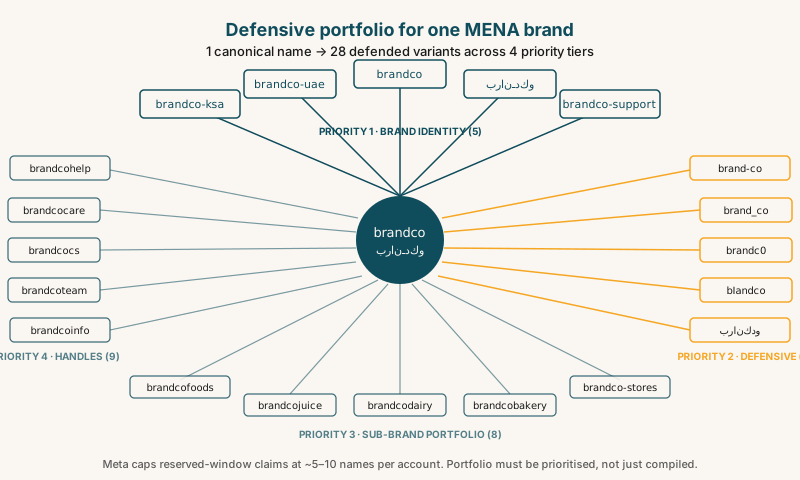
The diagram at the top of this page shows a sample defensive portfolio for a hypothetical MENA brand. The structure radiates from the canonical brand name at the center through the four priority tiers.
Priority 1 names (teal, top) are clustered around the canonical form, slight regional variants, the Arabic-script primary. Priority 2 names (amber, right side) are the visual confusables and common typo variants. Priority 3 names (bottom) are the sub-brand and product line handles. Priority 4 names (left side) are the operational handles.
The footnote on the diagram captures the key constraint: Meta caps reserved-window claims at ~5 to 10 names per account. A portfolio of 28 names requires either multiple verified accounts or careful prioritization of which 5 to 10 names are filed in the reserved window vs. which are registered in open launch.
Next step
Start with the free Username Watch. We monitor for Meta's reserved-window announcement and alert you the moment it opens. If you want to be portfolio-ready before the announcement, the Brand Pack engagement starts with a brand audit that maps your full name space and produces the prioritized defensive portfolio.