Why verification matters more in 2026
Meta restructured WhatsApp Business Platform's messaging-tier system in Q1 to Q2 2026, removing the graduated 2K → 10K → 100K per-day ladder that had defined WhatsApp Business capacity planning since 2021. The new model is binary: complete Meta Business Verification and unlock 100,000 conversations per day immediately. Don't complete it, and you're capped at 1,000 or 10,000 conversations per 24-hour period depending on your current tier.
For MENA operators running seasonal campaigns, Ramadan, Eid, National Day, Black Friday, the 10K ceiling is operationally crippling. A 100,000-contact Ramadan blast is impossible without verification. The tier-ladder workaround that used to be available (gradually earning capacity through quality metrics) no longer exists.
Verification also matters for account standing. Verified businesses have stronger standing in appeals processes when accounts are restricted, and receive faster resolution on customer-complaint escalations. The trust signal that verification provides to Meta's enforcement systems is increasingly visible in enforcement outcomes.
Why MENA self-serve verification fails
The verification process is a Facebook Business Manager flow. It accepts standard business documentation, incorporation certificates, trade licenses, commercial registrations, and cross-references them against public business registry data. For businesses in the US, UK, or EU, where that registry data is well-indexed and documents are typically in English, self-serve completion is straightforward.
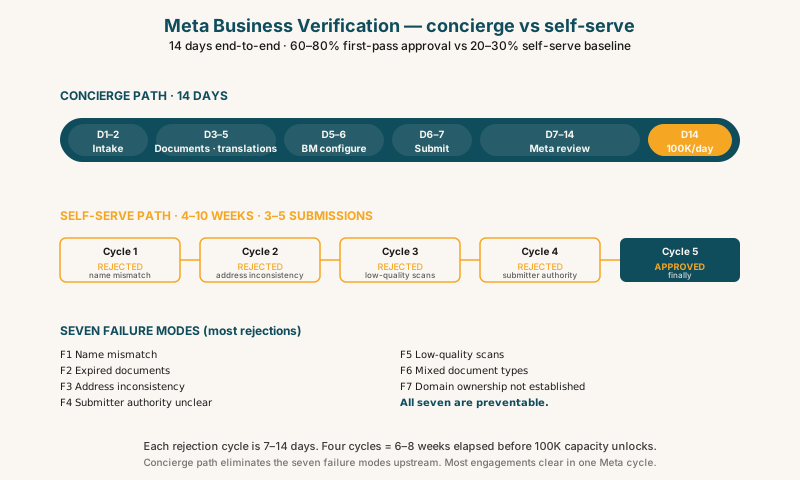
For MENA businesses, the combination of Arabic-language documents, diverse document types across 10+ different national jurisdictions, inconsistent romanization standards, and limited public registry coverage makes self-serve completion statistically unreliable. The typical MENA self-serve attempt cycles through 3 to 5 rejection cycles over 4 to 10 weeks before either approving or being abandoned.
Seven failure modes account for the large majority of rejections:
F1: Name mismatch. The business name in Business Manager doesn't match the legal name in the document. This is the single most common failure, and it's often not obvious, an English transliteration of an Arabic company name on one document, a different romanization on another, and a third variant in Business Manager. All three must match exactly.
F2: Expired documents. Commercial registrations and trade licenses have expiry dates. Most KSA CRs are annual. A document that was valid when gathered may have expired by the time of submission. Meta's reviewer rejects on expiry without flagging which document expired.
F3: Address inconsistency. The registered address on the document must match the address configured in Business Manager. Physical address formats across MENA are non-standardized (building names vs. street numbers vs. district-only addresses), and a mismatch in any element fails the check.
F4: Submitter authority unclear. The Facebook account submitting the verification request must be demonstrably authorized to act on behalf of the business. If the submitter isn't named as a director or authorized signatory on the document, additional authorization documentation is required.
F5: Low-quality scans. Mobile phone photos of documents are the norm for self-serve attempts. Meta's reviewers require legible text, visible document edges, and no obstructions. Shadows, reflections, and blurry text all trigger rejection.
F6: Mixed document types. Each jurisdiction requires a specific combination of documents. Submitting a trade license without the accompanying municipality certificate in UAE, or a CR without the chamber of commerce certificate in KSA, creates an incomplete package that fails review even when individual documents are valid.
F7: Domain ownership not established. The business domain used for verification must be confirmed as owned by the business via Business Manager's domain verification process. Self-serve attempts often submit without completing domain verification first, triggering a separate rejection.
Document requirements by jurisdiction
Saudi Arabia. Primary document: Commercial Registration (السجل التجاري) issued by the Ministry of Commerce. Supporting: Chamber of Commerce membership certificate (current year). For foreign-invested entities: foreign investment license (SAGIA/MISA). For individuals: National ID (هوية وطنية). CR must be current, KSA CRs are annual and the Ministry of Commerce issues renewals that look similar to originals; reviewers check the validity date.
UAE, Mainland DED entities. Trade License issued by the relevant emirate's Department of Economic Development. Must include the business activities listed (not the short-form license). For entities with GCC national shareholders, additional ownership structure documentation may be required. For entities with free-zone jurisdiction DED licenses, the distinction matters, see Free Zone section.
UAE, Free Zone entities. Free Zone Trade License from the relevant Free Zone authority (DIFC, ADGM, JAFZA, DMCC, etc.). Include the Free Zone authority's Certificate of Incorporation alongside the trade license. Free Zone entities receive additional reviewer scrutiny due to the diversity of Free Zone types, a covering document explaining the Free Zone's regulated status accelerates review.
Egypt. Commercial Register (السجل التجاري) issued by the General Authority for Investment and Free Zones (GAFI) or the relevant commercial registry. For sole proprietorships (منشآة فردية): individual establishment registration + proprietor's National ID (بطاقة الرقم القومي) + tax registration certificate. For joint-stock companies: Articles of Association + commercial register entry.
Kuwait. Commercial License (السجل التجاري) from the Ministry of Commerce and Industry. Attach the Chamber of Commerce membership and the relevant Ministry permit for the business activity type.
Qatar. Commercial Registration from the Ministry of Commerce and Industry (CR). The Qatari Commercial Register certificate is the primary document. For QFC entities: QFC license is the primary document.
Other GCC (Bahrain, Oman, Jordan). Equivalent primary commercial registration documents from the relevant Ministry of Commerce. Document requirements follow the same pattern as KSA/UAE but with jurisdiction-specific issuing authorities.
The English translation question
Meta's review queue processes documents in any language, but review latency differs. Arabic-only submissions average 7 to 14 days per review cycle. Submissions that include notarised English translations of primary documents average 3 to 5 days. For a 14-day engagement target, including translations is not optional, it's operationally necessary.
Notarised English translations from MENA-licensed translation offices cost approximately $50 to 150 per document depending on length and jurisdiction. This is the one cost that falls outside the fixed engagement fee, translation fees are paid to the translation provider and are not included in the concierge price. Most MENA companies need 1 to 2 documents translated; the CR or trade license is usually sufficient.
What the 14-day concierge process looks like
The 14-day timeline is structured around Meta's review latency, not arbitrary pacing. The prep work (Days 1 to 6) is done to eliminate all seven failure modes before submission, so the review cycle (Days 7 to 14) is clean.
Days 1 to 2: Intake. Arabic-native WhatsApp intake call. We gather the business entity name, jurisdiction, existing Business Manager setup, current document inventory, and submitter identity. Output: a specific document checklist with exact requirements for your entity type.
Days 3 to 5: Document preparation. We review documents against the checklist for validity, legibility, and completeness. Expired documents get flagged for renewal. Low-quality scans get re-captured at correct resolution. Notarised translation is coordinated where needed. Address formatting is verified against Business Manager configuration.
Days 5 to 6: Business Manager configuration. Business Manager entity is audited and corrected: name formatting, address formatting, domain verification, submitter authority documentation. Every field is matched against the document package before submission.
Day 6 to 7: Submission. Documents submitted with a covering note in English explaining the entity structure and document package. The covering note accelerates reviewer comprehension and reduces clarification requests.
Days 7 to 14: Review and response. Meta's review queue processes the submission. Most approvals come between Day 8 and Day 12. If Meta responds with a rejection, we read the feedback and submit a corrective response within 24 hours. 60 to 80% of engagements clear in this first cycle; the remaining 20 to 40% need one additional cycle.
What happens after verification
The 100K conversations per day tier unlocks immediately upon approval. No additional configuration is required on the Meta side. Your BSP may need to update your account tier settings to reflect the new limit, check with your BSP support within 24 hours of approval to ensure their platform reflects the unlocked capacity.
The post-verification ramp matters. Going from a 10K daily cap to a 100K cap doesn't mean you should immediately blast 100K messages the first day. Meta's quality rating system calibrates against volume changes, and a sudden 10× volume spike on templates with moderate quality scores can trigger pacing interventions. The Warmup Playbook provides a structured 90-day ramp: daily send volume recommendations, template performance review, and early-warning monitoring on quality signals during the ramp.
Next step
We assess your current Business Manager state, identify which document package applies to your entity, and tell you what we need from you to begin.